For Pakistani students planning to study in the UK, choosing the right UK study visa for Pakistani students is an important part of the journey. However, completing a visa application is not the first step in the process. Knowing which UK study visa option best suits your circumstances is the first step.
Depending on your age, the kind and length of your course, your educational provider, your financial situation, and your post-study plans, the UK offers a variety of immigration pathways.
For instance, a Pakistani student intending to finish their education will often need to look into the student visa. A student taking an eligible English-language course for more than six months but no more than 11 months may need a Short-term Study visa, while eligible short courses of up to six months can fall under the Standard Visitor route. Younger students attending an eligible independent school may need a Child Student visa.
Understanding these differences can help you avoid choosing a route simply because it worked for someone else.
What Are the Main UK Study Routes for Pakistani Students?
There are four main routes to consider when the primary purpose of travelling to the UK is study.
1. Student Visa
For international students 16 years of age or older who wish to enrol in approved further or higher education courses in the UK, the student visa is the main option.
A Confirmation of Acceptance for Studies (CAS), an offer from a licensed student sponsor, sufficient funds to maintain yourself and pay for your study, and
For a Pakistani student planning to study for a bachelor’s, master’s or another eligible higher-education qualification, this is usually the first route to investigate “how to apply for a UK Student visa from Pakistan”.
However, eligibility is not based simply on receiving an admission offer. Your course, institution, financial evidence and other circumstances can all matter.
2. Child Student Visa
The Child Student visa is designed for students aged between 4 and 17 who want to study at an eligible independent school in the UK.
Applicants need an unconditional offer from a licensed Child Student sponsor, suitable living arrangements, sufficient funds and parental or legal guardian consent. Students aged 18 or over generally need to consider the Student visa instead.
This means parents in Pakistan considering UK education for a school-age child need to look at a different route from the one used by university students.
3. Short-term Study Visa
The Short-term Study visa is specifically for eligible English-language courses lasting more than six months and up to 11 months.
It is not a general alternative to the Student visa. The route is specifically designed for qualifying English-language study, and it does not allow the holder to work or bring dependants.
If an English-language course lasts six months or less, the appropriate route may instead be the visitor route, depending on the circumstances.
4. Standard Visitor Route for Eligible Short Studies
A Standard Visitor can undertake certain types of study in the UK for up to six months.
For example, eligible visitors may study at an accredited institution on a course lasting no more than six months. The visitor route can also cover certain research activities, exams and other permitted educational activities.
However, a Standard Visitor visa is not a substitute for a Student visa when someone intends to undertake a longer course that requires student permission.
The purpose and length of your study are therefore important when determining the appropriate route.
Is the Student Visa the End of Your UK Journey?
Not necessarily.
For many Pakistani students, the visa they use to enter the UK for education may be the first stage of their UK journey, rather than the final immigration route they consider.
After successfully completing an eligible UK course, some students may be able to apply for the Graduate visa. This is an unsponsored route that allows eligible graduates to stay in the UK and work or look for work after completing their studies.
The Graduate visa currently lasts:
- 2 years for applications made on or before 31 December 2026
- 18 months for applications made on or after 1 January 2027
- 3 years for graduates who have completed a PhD or other doctoral qualification
The Graduate route is not automatically available simply because someone studied in the UK. The course, education provider and period of study must meet the relevant eligibility requirements.
What Routes Can Pakistani Students Consider After Studying in the UK?
Graduate Visa
The Graduate visa can provide eligible international graduates with time to remain in the UK after completing their studies.
It allows graduates to work in most jobs, look for employment and, subject to the rules, be self-employed. Since it’s an unsponsored path, you can apply without a job offer or employer sponsorship.
But it’s crucial to recognise that the Graduate route cannot be easily extended and is not a permanent immigration path. If a graduate wants to stay in the UK after this time, they might need to be eligible for another path.
Skilled Worker Visa
For some graduates, the next step may be the Skilled Worker visa.
For qualified positions with authorised UK businesses, the Skilled Worker path is available. A verified work offer, a Certificate of Sponsorship, a suitable occupation, and the necessary pay are typically required for applicants. Additionally, they have to fulfilll the pertinent English language criteria.
Although various wage regulations and deductions may be applicable in specific situations, the standard income requirement is typically £41,700 annually or the market rate for the occupation, whichever is higher.
For this reason, before selecting a course, students should consider their career goals.
A course shouldn’t be chosen just because it provides a route to the UK. Additionally, students should think about how it fits with their long-term plans, career aspirations, and academic interests.
Can Family Circumstances Provide Another UK Visa Route?
Family ties may have an impact on a person’s immigration prospects in certain situations.
Study routes and family-related routes, however, are distinct. A student should not believe that they are automatically qualified for a family visa just because they have a family member in the UK.
The particular relationship, the family member’s immigration status in the UK, and the prerequisites of the applicable family route all affect eligibility.
Which UK Visa Route Is Right for You?
There is no single UK visa route that is right for every Pakistani student.
A useful starting point is to ask why you want to go to the UK and what you plan to do there.
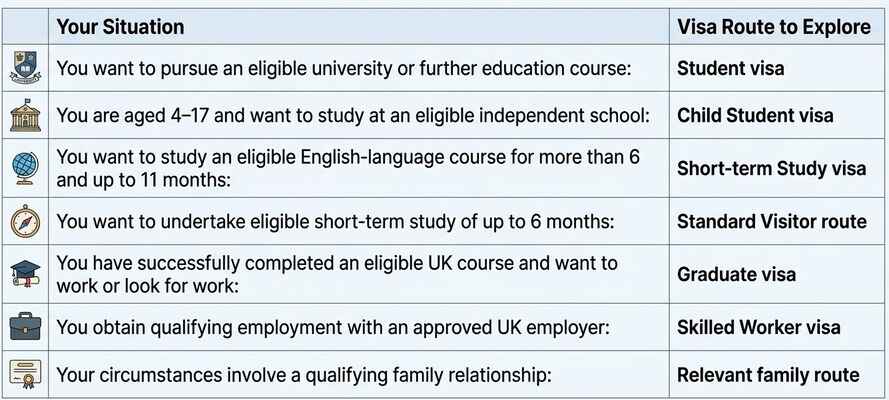
This table is a starting point, not a substitute for an individual eligibility assessment. UK immigration rules can contain exceptions, additional requirements and restrictions depending on your circumstances.
What Should Pakistani Students Consider Before Choosing a UK Visa Route?
Before deciding which route to pursue, consider more than just the visa name.
Your academic background
Your previous qualification, academic progression and chosen level of study can influence which courses and study routes are appropriate.
Your chosen course
The type, level and duration of your course can affect which immigration route applies.
Your education provider
Your university, college or school must meet the relevant sponsorship or accreditation requirements for the route you are considering, choose the right university and course. For example, a Student visa requires a licensed student sponsor.
Your finances
You may need to demonstrate that you can pay your course fees and support yourself according to the requirements of your particular route.
Your English-language ability
English-language requirements can apply depending on the route and circumstances.
Your career plans
If your goal is to work in the UK after graduation, it is useful to understand the post-study options before choosing your course. A Graduate visa may provide an eligible graduate with time to work or look for work, while a Skilled Worker route may become relevant if the graduate later obtains qualifying sponsored employment.
Your personal circumstances
Your age, family situation, previous immigration history and other personal circumstances can affect your options.
Why Should Pakistani Students Get Professional UK Visa Guidance?
It takes more than just knowing the names of various visa categories to select a UK immigration route.
Which path you may be eligible for depends on a number of factors, including your academic history, chosen course, institution, English language proficiency, financial situation, professional goals, and personal circumstances.
Professional advice can be helpful in this situation.
A competent UK study abroad advisor should do more than just advise you on the visa to apply for. A detailed assessment of your profile and academic objectives should be the first step in the process. Understanding your situation, identifying pertinent possibilities, properly outlining the needs, and offering frank advice about what might or might not work for you should be the main goals.
The objective should be to understand your circumstances, identify the relevant options, explain the requirements clearly and provide honest advice about what may or may not work for you.
Most importantly, no consultant can guarantee that a visa application will be approved. The final decision rests with the relevant UK authorities.
Get Guidance Before You Choose Your UK Study Route
If you are a Pakistani student planning to study in the UK, do not begin with the question:
“Which visa should I apply for?”
Start with:
“What do I want to study, why do I want to study in the UK, and which immigration route fits my circumstances?”
Once you understand your options, you can make a more informed decision about your university, course, finances and future plans.
At Global Skies Consultants, the focus is on helping Pakistani students understand their study-abroad options and prepare their applications with greater clarity and confidence.
Whether you are exploring a UK university, comparing courses, understanding visa requirements or planning your post-study career direction, a proper profile assessment can help you understand the route that may fit your goals.