Choosing between Chevening vs Fulbright fully funded scholarship programs depends on several factors. These include your degree level, academic goals, work experience, preferred study destination, and plans after graduation.
Chevening supports one-year taught master’s degrees in the UK. The Fulbright Degree Program in Pakistan supports master’s and PhD study in the United States.
Both scholarships provide substantial financial support. But getting a fully funded scholarship needs expert guidance. For this purpose, students need to consult with Global Skies study abroad consultants. The study abroad experts can guide students on eligibility criteria, application processes, testing requirements, and post-scholarship conditions.
If you are a Pakistani student deciding between these two scholarships, Global Skies consultants can help you choose the program that matches your academic and career plans.
What Is the Difference Between Chevening and Fulbright Scholarship?
The main difference between Chevening and Fulbright Scholarship is the degree and study destination they support. Chevening funds one-year taught master’s degrees in the UK. Fulbright Pakistan funds both master’s and PhD study in the United States.
Chevening places strong emphasis on leadership, networking, and future career goals. Fulbright combines academic study with the broader goal of educational and cultural exchange.
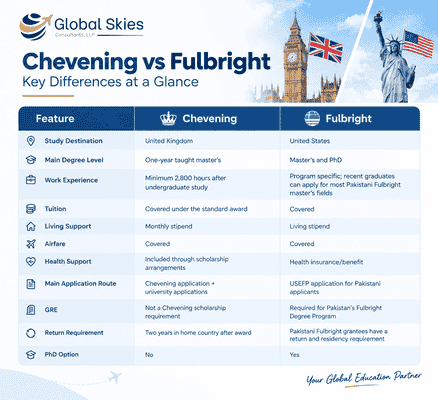
Fulbright requirements can vary by country. Pakistani applicants should use USEFP’s requirements. They should not rely on general Fulbright information from another country.
Chevening vs Fulbright: Which Scholarship Is Better?
Neither Chevening nor Fulbright is universally better. The more suitable scholarship depends on your degree, destination, experience, academic goals, and plans after graduation. Chevening may suit applicants who want a one-year master’s in the UK. It is also designed for applicants who meet its work experience and leadership-focused requirements. Fulbright may suit applicants who want to pursue a master’s or PhD in the United States.
For a Pakistani student, you can narrow down your options by asking:
- Do you want to study in the UK or USA?
- Are you applying for a master’s or PhD?
- Do you already have the work experience required by Chevening?
- Are you prepared to take the GRE required by Pakistan’s Fulbright Degree Program?
- Does your preferred program meet the scholarship’s eligibility requirements?
- Are you comfortable with the return-home conditions attached to the award?
At Global Skies Consultants, we help students understand these factors before they start preparing their applications. This allows you to build your scholarship plan around your actual academic profile and study goals instead of applying without a clear direction.
Which Is More Competitive, Chevening or Fulbright?
Both Chevening and Fulbright are highly competitive scholarships. However, their selection processes use different criteria.
Chevening describes its application process as competitive. It assesses applications based on its eligibility criteria and selection objectives.
USEFP describes Pakistan’s Fulbright program as highly competitive and merit-based.
Chevening looks for evidence of leadership, relationship-building, career direction, and future contribution. Fulbright Pakistan considers academic strength, leadership potential, and commitment to contributing to Pakistan.
The two programs also have different applicant pools and degree options. Their selection criteria are different as well.
Because of these differences, a simple acceptance-rate comparison does not tell the whole story.
What Does the Chevening Scholarship Cover?
The Chevening Scholarship covers tuition fees, economy travel, a monthly living allowance, visa-related costs, and several additional allowances for eligible scholars.
Chevening states that its standard scholarships are fully funded. The funding is designed to help scholars focus on their studies and professional development.
The award can include:
- University tuition fees
- Economy return travel
- Monthly living stipend
- Arrival allowance
- Departure allowance
- Visa application cost
- Travel top-up allowance
- Certain required testing costs, where applicable
For many Pakistani students, this can make studying in the UK significantly more financially accessible.
However, receiving this opportunity requires a strong and carefully prepared application.
Global Skies Consultants can help you understand the Chevening requirements, organize your application, develop your written responses, and prepare for the stages that follow if you are shortlisted.
What Does the Fulbright Scholarship Cover?
Absolutely, the Fulbright Degree Program in Pakistan covers major study and living expenses. These include tuition, required textbooks, airfare, a living stipend, and health insurance.
USEFP also lists several additional benefits. These include visa fees, a computer allowance, and a settling-in allowance.
Fulbright funding is administered differently across countries. But the application process requires careful preparation.
From understanding the eligibility criteria to preparing for the GRE, developing your personal statement, preparing documents, and getting ready for the selection process, students need to approach the application strategically.
Global Skies Consultants provides guidance throughout these stages so students can prepare their applications with greater confidence.
What Are the Pros and Cons of Fulbright and Chevening Scholarship?
The advantages and limitations of Fulbright and Chevening depend on your academic plans and personal circumstances. To achieve these fully funded scholarships, one needs to consult with expert study abroad consultants.
Chevening advantages
- Fully funded master’s study in the UK
- One-year taught master’s structure
- No upper age limit
- Strong international alumni and professional networking opportunities
- No Chevening-specific English-language test requirement
- Multiple eligible UK course choices
- Living and travel support
Chevening considerations
- Requires at least 2,800 hours of work experience after undergraduate study
- Only eligible taught master’s programs are covered
- Does not fund PhD programs
- Applicants must commit to returning home for two years
- The scholarship does not financially support dependants
- MBA applicants may face a tuition-fee cap and may need to cover costs above the specified limit.
Fulbright advantages
- Supports master’s and PhD study in Pakistan’s Fulbright Degree Program
- Covers major study and living costs
- Provides an opportunity to study at U.S. universities
- Recent graduates can apply for most master’s fields in Pakistan
- Open to a wide range of academic disciplines, excluding clinical medicine
- Includes airfare and health insurance
Fulbright considerations
- Requirements vary by country and program
- Pakistani applicants must take the GRE General Test
- Selected Pakistani candidates must demonstrate English proficiency and take the TOEFL
- PhD applicants generally need a master’s, MPhil, or comparable qualification
- Pakistani Fulbright grantees have a mandatory return and residency requirement
- Applicants must be prepared to complete the grant without accompanying dependants if necessary.
What Is the Eligibility Criteria for Chevening and Fulbright Scholarship?
Chevening requires an eligible nationality, a qualifying undergraduate degree, at least 2,800 hours of work experience, three eligible UK course choices, and a commitment to return home for two years.
Fulbright eligibility varies by country. Pakistani applicants have specific academic, testing, and residency requirements.
Chevening eligibility criteria
Applicants must:
- Be a citizen of a Chevening-eligible country or territory
- Hold an undergraduate degree qualifying them for a UK master’s
- Have at least 2,800 hours of work experience acquired after undergraduate study
- Apply to three eligible UK master’s courses
- Obtain an unconditional offer from at least one selected course by the relevant deadline
- Commit to returning to their country of award for at least two years after the scholarship
There is no upper age limit for Chevening. If you are already a master’s degree holder, it does not automatically prevent you from applying for another master’s through Chevening. Additionally, your application also needs to demonstrate why you are a suitable candidate for the program.
Fulbright eligibility for Pakistani students
For Pakistan’s Fulbright Degree Program:
- Master’s applicants need a four-year bachelor’s degree or a bachelor’s and master’s combination totaling 16 years of formal education.
- PhD applicants need a master’s, MPhil, or comparable degree representing at least 18 years of formal education.
- All academic fields are eligible except clinical medicine.
- The GRE General Test is required.
- Applicants must have strong English-language proficiency.
- Applicants must be Pakistani citizens residing in Pakistan throughout the application process.
- Successful applicants must commit to returning to Pakistan.
Global Skies Consultants can help you review your academic background and understand whether your profile aligns with the scholarship requirements before you begin preparing your application.
Do Chevening and Fulbright Require Work Experience?
Chevening requires at least 2,800 hours of work experience. Fulbright work experience requirements depend on the country and program.
For Pakistani Fulbright applicants, recent graduates are encouraged to apply to the master’s program. However, MBA and Public Policy/Public Administration applicants require two years of relevant work experience.
Chevening accepts several types of work experience. These include:
- Full-time employment
- Part-time employment
- Voluntary work
- Paid internships
- Unpaid internships
For Fulbright Pakistan, PhD applicants are expected to have strong academic preparation, and teaching, research, or public-sector experience is highly desirable. To confirm your eligibility for the fully funded scholarship, you need to consult with study abroad experts. They will help you evaluate your options before you apply.
Is Chevening and Fulbright for Master’s or PhD?
Chevening is for eligible one-year taught master’s degrees. Fulbright Pakistan supports both master’s and PhD degrees.
Chevening does not fund PhD or DPhil programs under its standard scholarship.
Chevening master’s requirements
Chevening courses must be full-time, taught master’s programs based in the UK.
These courses normally last between nine and twelve months.
Research-focused MRes programs are not eligible. Part-time courses, distance-learning courses, and PhD programs are also not eligible.
How Long Does Fulbright and Chevening Funding Last?
Chevening normally funds a one-year master’s degree, while Fulbright funding lasts according to the approved degree program and grant arrangements. Chevening scholarships generally cannot extend beyond 12 months except under limited circumstances, whereas Fulbright master’s and PhD awards are structured around the duration and requirements of the graduate program.
For Fulbright, applicants should check their specific award terms because funding duration can differ according to the program and degree.
Does Chevening or Fulbright Require IELTS, GRE, or Another Test?
Chevening itself does not require an English-language test, while Pakistan’s Fulbright Degree Program requires the GRE General Test and selected candidates must take the TOEFL. University-specific English-language requirements can still apply to Chevening applicants, and Fulbright requirements can differ between countries.
Does Chevening require IELTS?
Chevening does not impose its own English-language test requirement. However, the UK university and course you apply to may require IELTS, TOEFL, PTE, or another accepted test to demonstrate English proficiency.
Does Fulbright Pakistan require GRE?
Yes. USEFP states that the GRE General Test is required for applicants to both its master’s and PhD Fulbright programs. The published minimum is 145 on each section under the current scoring system.
Does Fulbright Pakistan require TOEFL?
Selected candidates are required to take the TOEFL, according to USEFP’s Fulbright Degree Program information.
How Do I Apply for Chevening and Fulbright Fully Funded Scholarship?
You apply for Chevening through the official Chevening application system and apply to your selected UK universities separately, while Pakistani applicants apply for Fulbright through USEFP. The two application processes are separate and have different document, testing, and university-placement requirements.
For Chevening, applicants select three eligible master’s courses and apply to the universities directly. At least one of those choices must result in an unconditional offer by the relevant deadline.
For Fulbright Pakistan, applicants submit the required application materials to USEFP. The process then includes review, selection, and university placement.
What Documents Are Required for Fulbright and Chevening Scholarship?
Chevening and Fulbright require different application documents, but both require applicants to provide evidence of their academic background and supporting information that demonstrates their suitability for the scholarship.
Chevening documents and information
Applicants should be prepared to provide:
- Personal and contact information
- Education history
- Work-experience information
- Three selected UK courses
- Leadership and networking examples
- Career plans
- Two referee details
- University offer documentation at the required stage
Chevening asks applicants to demonstrate leadership, relationship-building, course selection, and future career goals through the application.
Fulbright Pakistan documents
USEFP’s application requirements include:
- Completed application form
- Three reference letters
- GRE score report
- Scanned academic transcripts
- Explanation of the university’s grading scale
Applicants should always check the current USEFP application instructions before submitting because requirements and deadlines can change.

How Do I Write a Chevening and Fulbright Fully Funded Scholarship Personal Statement?
A strong Chevening or Fulbright scholarship personal statement should connect your academic background, experience, goals, leadership or impact, and reasons for pursuing the proposed program into a clear and credible story. The statement should demonstrate evidence rather than relying on broad claims about ambition or passion.
For Chevening, pay particular attention to the areas the scholarship assesses, including leadership and influencing, networking and relationship-building, course choices, and career plans.
For Fulbright, your application should clearly communicate your academic preparation, proposed field of study, future objectives, and how your education can contribute after you return home. USEFP specifically emphasizes applicants’ commitment to returning and serving Pakistan.
A useful structure is:
- Your background: What academic or professional experience shaped your goals?
- Your evidence: What have you actually achieved?
- Your motivation: Why do you need this particular degree?
- Your future plan: What will you do with the knowledge?
- Your impact: How will your education contribute to your community, profession, or country?
Avoid turning the personal statement into a list of achievements. Each example should help explain why you are prepared for the scholarship and what you intend to accomplish afterward.
What Mistakes Should Students Avoid in Fulbright and Chevening Applications?
The biggest application mistakes are failing to meet eligibility requirements, submitting incomplete information, giving generic answers, and failing to connect your study plans with credible future goals. Applicants should also avoid copying statements from other applications or relying on unsupported claims about leadership and impact.
For Chevening, common problems include:
- Not meeting the 2,800-hour work-experience requirement
- Selecting courses that do not form a coherent academic or career direction
- Giving vague leadership examples
- Failing to demonstrate relationship-building
- Waiting too long to apply to universities
- Ignoring the requirement for an unconditional offer from one selected course
For Fulbright Pakistan, applicants should avoid:
- Missing the GRE requirement
- Submitting incomplete transcripts or references
- Ignoring the specific degree requirements
- Applying for an excluded field such as clinical medicine
- Providing weak or generic academic and career goals
- Failing to demonstrate commitment to returning to Pakistan
Chevening states that applications are screened and reviewed against eligibility and selection criteria, while USEFP requires a complete application package for Fulbright Pakistan.
What Does Chevening and Fulbright Look for in Applicants?
Chevening looks for applicants who can demonstrate leadership, influence, relationship-building, clear career goals, and the potential to contribute after returning home, while Fulbright Pakistan evaluates academic strength alongside leadership potential and commitment to contributing to Pakistan. The programs therefore overlap in their interest in future impact but assess applicants through different frameworks.
A high GPA alone does not automatically make an applicant successful. Your academic record is one part of an application that also needs to demonstrate purpose, preparation, relevant experience, and a realistic plan for using the opportunity.
How Competitive Are Chevening and Fulbright Scholarships?
Chevening and Fulbright scholarships are both competitive, but the programs should not be judged by a single competition figure because they operate with different eligibility rules, applicant pools, degree options, and selection systems. Chevening describes its scholarship as competitive and challenging, while USEFP describes the Pakistani Fulbright program as highly competitive and merit-based.
For Pakistani applicants, USEFP reported that 85 Pakistani students and researchers were awarded Fulbright scholarships for graduate study in the United States in 2026.
The number of awards in a particular year should not be treated as an acceptance rate unless it is compared with the corresponding number of eligible applicants for that same program and cycle.
Can Pakistani Students Apply for Both Chevening and Fulbright?
Yes, Pakistani students can apply separately for Chevening and Fulbright if they meet the eligibility requirements of both programs. Applying to both can allow an eligible applicant to pursue two different scholarship opportunities, although each application must independently satisfy its program’s requirements. Chevening has its own eligibility and application process for Pakistan, while Fulbright Pakistan is administered by USEFP.
The important point is that the applications should not simply be copied from one another. Chevening emphasizes leadership, influence, relationships, course choices, and career plans, while Fulbright Pakistan places substantial emphasis on academic preparation, testing, proposed study, and contribution to Pakistan.
Can Students Stay in the UK or USA After Chevening and Fulbright Scholarship?
Chevening scholars must return to their home country for at least two years after the scholarship, while Pakistani Fulbright grantees are required to return to Pakistan and fulfill a residency requirement. This is an important difference for students whose long-term plans include working abroad after graduation.
Can Chevening scholars work in the UK after graduation?
Chevening scholars cannot remain in the UK under the Graduate Route after completing their scholarship because accepting the award includes a commitment to return home for two years. Chevening states that scholars cannot use repayment of scholarship funds to bypass this condition.
Can Fulbright scholars work in the USA after graduation?
Pakistani Fulbright grantees are subject to the program’s return and residency requirements. USEFP states that Pakistani Fulbright awardees must return to Pakistan within 30 days of completing their programs and fulfill a residency requirement of at least two years.
Because U.S. immigration rules can be complex, Fulbright recipients should follow the conditions attached to their specific J-1 status and grant rather than assuming that completing the degree automatically permits continued employment in the United States.
Can Students Take Their Family With Them on Chevening or Fulbright?
Chevening does not provide financial or immigration support for dependants, while Fulbright arrangements for accompanying dependants can vary by country and grant, so Pakistani applicants should not assume that family travel will be funded. Chevening specifically advises scholars against bringing dependants because the scholarship is calculated around the scholar’s own costs and does not cover dependent travel or support.
For Fulbright Pakistan, USEFP states that applicants should be prepared to complete their grants without accompanying dependants if necessary. Therefore, applicants with spouses or children should check the current Fulbright and U.S. visa rules before making family relocation plans.
What Happens After Completing Fulbright and Chevening Scholarship?
After completing Chevening or Fulbright, scholars return to their home countries under the applicable scholarship conditions and join the programs’ alumni networks and activities. Both scholarships are designed to extend their impact beyond the period of study through professional connections, knowledge sharing, and alumni engagement.
Chevening requires scholars to return home for at least two years after completing the award and provides an international alumni network.
For Pakistani Fulbright alumni, USEFP provides alumni activities and grants designed to support educational and professional initiatives in Pakistan.
Is Chevening and Fulbright a Fully Funded Scholarship?
Yes, Chevening is a fully funded scholarship, and the Fulbright Degree Program in Pakistan is also presented by USEFP as a fully funded program covering major costs such as tuition, airfare, living expenses, and health insurance. However, applicants should always check the exact award terms because funding structures differ between Fulbright country programs and individual awards.
For Chevening, the standard award includes tuition, travel, living support, and several additional allowances.
For Fulbright Pakistan, the grant covers tuition, textbooks, airfare, a living stipend, health insurance, visa fees, a computer allowance, and a settling-in allowance according to USEFP’s published information.
Is Chevening and Fulbright a Fully Funded Scholarship?
Yes, Chevening is a fully funded scholarship, and the Fulbright Degree Program in Pakistan is also presented by USEFP as a fully funded program covering major costs such as tuition, airfare, living expenses, and health insurance. However, applicants should always check the exact award terms because funding structures differ between Fulbright country programs and individual awards.
For Chevening, the standard award includes tuition, travel, living support, and several additional allowances.
For Fulbright Pakistan, the grant covers tuition, textbooks, airfare, a living stipend, health insurance, visa fees, a computer allowance, and a settling-in allowance according to USEFP’s published information.
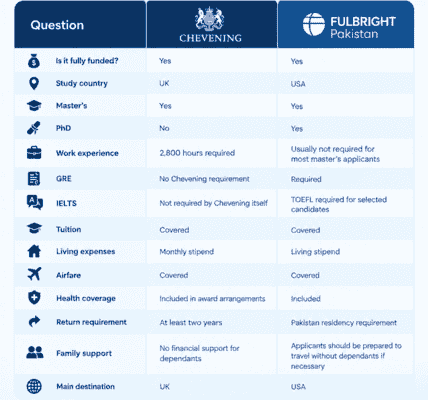
Chevening vs Fulbright Fully Funded Scholarship: Quick Comparison
Start Your Fully Funded Scholarship Journey With Global Skies Consultants
If you are a Pakistani student who wants to get a full scholarship to study in the UK or USA, Global Skies Consultants can help you learn about your options, get your application ready, and prepare for the scholarship interview.
Your international education journey starts with choosing the right path.
Get expert advice on how to study abroad from Global Skies Consultants and take the next step toward your goal of getting a full grant.